Fuhengli Aluminum LCD Power Supply Review (2026): A Spec-Based Look
As an Amazon Associate we earn from qualifying purchases. Links on this page are affiliate links.
This fuhengli computer PC power supply review covers a compact diagnostic tool designed for quick hardware checks. The unit features an aluminum alloy enclosure that provides durability while keeping the weight down to just 3.1 ounces. It includes a 1.8-inch LCD screen to display voltage readings for ATX, SATA, and other connectors. This device helps you verify if your power supply is delivering stable power before installing it in a case. Its small size makes it easy to carry in a tool kit. The tester supports multiple connector types, including 20-pin and 24-pin ATX inputs, making it versatile for various system builds.
What stands out
- Supports 8-in-1 testing for 20-pin ATX, 24-pin ATX, HDD, Floppy, PCI-e, and SATA connectors.
- Lightweight aluminum alloy enclosure measuring 2.6 x 4.9 x 0.63 inches.
- 1.8-inch LCD screen displays voltage outputs for main and auxiliary connectors.
- Built-in buzzer alarm activates when voltage readings fall outside normal ranges.
Who it fits
Good fit for
This tester suits PC builders and technicians who need to verify power supply functionality before installation. It is ideal for those working with various connector types, including older IDE drives and modern SATA devices. The compact aluminum design benefits users who travel or maintain multiple workstations. If you want to quickly check if a PSU is dead or delivering correct voltages, this tool offers a straightforward solution without complex setup.
Who should skip it
You should look elsewhere if you need to test high-end server power supplies with non-standard connectors. This device cannot fit PCI-e 8-pin connectors, which limits its use for some modern graphics cards. Additionally, the 1.8-inch LCD screen is prone to scratching, so you may need to remove the protective film for better visibility. If you require a larger display or automated data logging, this basic analog-style tester may not meet your professional needs.
Verdict: This is a practical, lightweight tool for verifying basic power supply voltages across multiple connector types. Its aluminum build and simple LCD interface make it suitable for quick diagnostics in most standard PC setups.
Key specs explained
8-in-1 ATX Power Supply Tester
This feature allows the device to test multiple connector types, including 20-pin, 24-pin ATX, HDD, Floppy, PCI-e 6-pin, 4-pin, and EPS 8-pin. It simplifies diagnostics by supporting various legacy and modern power standards in a single unit. You benefit from having one tool for diverse hardware checks without needing separate adapters. When shopping, look for models that cover your specific connector needs to ensure compatibility with your existing equipment.
Aluminum Alloy Enclosure
The casing is made from aluminum alloy, which offers high strength and good thermal conductivity. This material choice makes the device lightweight at 3.1 ounces while remaining durable and resistant to corrosion. You gain a portable tool that is easy to carry and handle during routine maintenance. When comparing power supplies and testers, consider how the build quality affects longevity and resistance to physical damage in a busy workspace.
1.8'' LCD Screen
A small liquid crystal display shows output voltages such as +3.3V, +5V, and +12V directly on the device. This visual feedback helps you quickly verify if a power supply is delivering correct electrical levels. The screen is powered by the tested connector, eliminating the need for extra batteries. When evaluating diagnostic tools, prioritize those with clear displays to reduce reading errors and speed up your troubleshooting process effectively.
Beep Alarm
The unit includes a buzzer that sounds when test values fall outside the normal range. This auditory alert provides an immediate warning without requiring you to constantly watch the screen. It helps you identify faulty power supplies quickly during rapid testing sessions. When choosing a tester, consider whether audible feedback suits your workflow better than visual-only indicators, especially in noisy environments or when checking multiple units in succession.
Build Quality and Physical Layout
The Fuhengli unit uses an aluminum alloy enclosure, which the listing notes provides high strength and corrosion resistance. This material choice also offers good thermal conductivity, helping to dissipate heat during operation. The design keeps the device lightweight at 3.1 ounces, making it easy to carry in a tool bag or pocket. Its compact dimensions are 4.9 inches in length, 2.6 inches in width, and 0.63 inches in height. This small footprint allows you to place it on a workbench without taking up much space.
The front face features a 1.8-inch LCD screen that displays voltage readings for 20-pin and 24-pin connectors. According to the listing, this screen is powered directly by the tester’s connection to the PSU, so you do not need a separate power source. The display shows values like +3.3V, +12V, +5V, and -12V. To protect the display from scratches, the manufacturer includes a protective film that you can remove if desired.
Controls are minimal, relying on visual indicators and an audible alert. A beep alarm sounds when test values fall outside the normal range, giving you immediate feedback. LED lights on the left side indicate status for IDE, Floppy, and SATA connectors. This straightforward layout means you can quickly identify issues without navigating complex menus. The finish is utilitarian, focusing on function rather than aesthetics. This practical design suits technicians who need a reliable, portable tool for frequent hardware diagnostics.
Setup and Daily Use Guide
Using this tester requires no complex installation or software drivers. You simply connect the appropriate cable from your power supply to the corresponding port on the device. The unit supports 20-pin and 24-pin ATX connectors, as well as legacy and modern options like HDD IDE, Floppy 4-pin, PCI-e 6-pin, 4-pin, and EPS 8-pin. Note that the listing specifies it cannot fit the PCI-e 8-pin connector. Once connected, the 1.8-inch LCD screen powers directly from the 20-pin or 24-pin connector, eliminating the need for an external power source for the display.
For daily diagnostics, the screen displays specific voltage readings for the main connectors. You will see values for +3.3V, +12V1, +5V, -12V, 5VSB, and PG. The screen does not display +12V2 for these main connectors. If you test PCI-e, 4-pin, or EPS 8-pin connectors, the screen shows +12V2 instead. For SATA, IDE, and Floppy connectors, the tester uses LED lights on the left side rather than the LCD. The IDE and Floppy connectors light up for +12V and +5V. The SATA connector lights up for +12V, +3.3V, and +5V. You must check the wire count on your SATA connector. A normal 5-wire connector shows three lights, while a 4-wire connector shows only two. If any voltage exceeds the normal range, a buzzer alarm sounds to alert you. This setup allows you to quickly verify power supply output without additional tools.
Before You Buy This Tester
You should verify your power supply connectors match the eight types this unit supports. Note that it cannot fit PCI-e 8-pin connectors. The device displays voltages for 20-pin and 24-pin ATX, as well as SATA, IDE, and floppy ports. You need to check your specific connector wire counts, especially for SATA, as the LED indicators change based on whether you have four or five wires. Keep the protective film on the 1.8-inch LCD screen to prevent scratches, or remove it if you prefer a clear view. This aluminum alloy tool is lightweight and portable, making it easy to carry alongside other diagnostic gear. It fits well in a technician’s kit or a home workshop. You will not need drivers or software. Just plug in and read the results. It serves as a quick verification step before deeper system troubleshooting.
Check before you buy
- Confirm your PSU has 20-pin or 24-pin ATX connectors
- Check that you do not need PCI-e 8-pin testing
- Verify SATA connector wire counts for accurate LED readings
- Ensure you have a standard PC power supply to test
The product at a glance
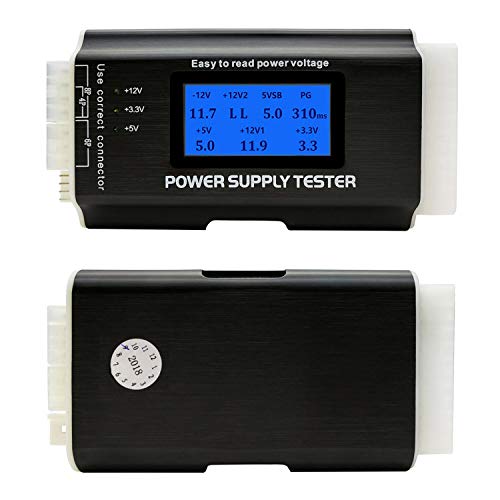
Fuhengli Aluminum LCD Power Supply Tester
Best for: Quick verification of standard ATX and peripheral connectors
- Form Factor
- ATX
- Device Compatibility
- PCs
- Display Type
- LCD Display
- Dimensions
- 4.9 × 2.6 × 0.63 inches
- Weight
- 3.1 ounces
View on Amazon: Fuhengli Aluminum LCD Power Supply Tester Affiliate link
This Fuhengli tester checks 20-pin, 24-pin, SATA, IDE, floppy, and PCIe connectors. A 1.8-inch LCD screen shows voltage readings for ATX and PCIe pins. LED lights indicate status for storage and floppy connectors. The aluminum alloy enclosure is compact, measuring 4.9 by 2.6 by 0.63 inches and weighing 3.1 ounces. It includes a beep alarm for out-of-range voltages. This tool suits technicians who need a portable, spec-focused way to verify power supply outputs quickly.
Pros
- Tests 8 connector types including ATX, SATA, and PCIe
- 1.8-inch LCD displays voltage values clearly
- Aluminum alloy enclosure offers corrosion resistance
- Built-in beep alarm signals abnormal voltage levels
Cons
- LCD screen is prone to scratches
- Does not support PCI-e 8-pin connectors
- Requires manual interpretation of LED lights for SATA
Good fit if
- You need to verify multiple connector types quickly
- You prefer a lightweight, portable testing device
- You want audible alerts for voltage errors
Skip if
- You require testing for PCI-e 8-pin connectors
- You need a large, high-resolution display
- You want automatic LED interpretation for all SATA variants
Verdict: Fuhengli 8-in-1 ATX PSU Tester is a compact, spec-driven tool for verifying standard ATX and peripheral power outputs. It fits technicians who prioritize portability and clear voltage readings over advanced connector support.
Specifications side by side
| Spec | Fuhengli Aluminum LCD Power Supply Tester |
|---|---|
| Form Factor | ATX |
| Device Compatibility | PCs |
| Display Type | LCD Display |
| Dimensions | 4.9 × 2.6 × 0.63 inches |
| Weight | 3.1 ounces |
| Color | Aluminum Alloy Enclosure |
| Model | PC - PSU Tester |
Frequently asked questions
Is the Fuhengli PSU tester suitable for laptops?
No, this device is designed exclusively for desktop computer power supplies. It supports standard ATX connectors and peripheral cables like SATA and PCI-e. Laptops use proprietary DC adapters and internal battery systems that this tool cannot interface with. You need a specialized multimeter or laptop-specific diagnostic kit for mobile hardware checks.
Does this tester require software installation?
No, the Fuhengli unit operates independently without any drivers or software. It is a standalone hardware diagnostic tool that reads voltage levels directly from the power supply connectors. You simply plug in the cables, and the LCD screen displays the results instantly. This makes it ready for immediate use in any workshop environment.
Can it test 8-pin PCI-e connectors?
No, the product data indicates it supports 6-pin PCI-e connectors but not 8-pin versions. It is an 8-in-1 tester covering ATX 20/24-pin, HDD, Floppy, PCI-e 6-pin, and 4-pin EPS. If your power supply relies on dual 8-pin GPU connections, this tool will not verify those specific rails.
How portable is the aluminum enclosure design?
The unit is highly portable due to its compact dimensions and lightweight construction. It measures 4.9 inches in length, 2.6 inches in width, and weighs only 3.1 ounces. The aluminum alloy casing adds durability without significant bulk, making it easy to carry in a tool bag or keep on a workbench for quick checks.
What voltage rails does the LCD display?
The screen displays voltage readings for standard ATX power lines. It covers the 3.3V, 5V, and 12V rails typically found in 20-pin and 24-pin ATX connectors. It also checks auxiliary rails for peripheral devices like SATA and IDE drives. The digital readout provides clear numerical values to help you verify power stability.
Is this tool safe for beginners?
Yes, it is designed for straightforward, safe operation. There are no complex settings or calibration steps required. You just connect the power supply cables to the matching ports on the device. The aluminum enclosure provides some protection, and the simple plug-and-play nature reduces the risk of user error during basic power supply verification.