Size Explained: What It Means for PC Power Supplies
As an Amazon Associate we earn from qualifying purchases. Links on this page are affiliate links.
Size Explained for Power Supplies
When you shop for a PC power supply, the term size explained often causes confusion. You might see numbers like 650W or 1000W and wonder if they refer to physical dimensions. They do not. In this context, size refers to the maximum wattage output the unit can deliver to your components. This specification is the most critical factor in ensuring your system runs stably under load.
Wattage indicates the total power available to your motherboard, CPU, graphics card, and storage devices. A 650W unit provides enough energy for entry-level builds with integrated graphics or low-power CPUs. If you add a mid-range graphics card, you may need to step up to 750W. High-end gaming rigs or workstations with multiple GPUs often require 850W or 1000W units to handle peak power spikes without shutting down.
For professional workstations or servers, 1200W units offer headroom for extreme configurations. It is important to understand that higher wattage does not mean the unit constantly draws that much power from your wall outlet. It simply means the unit can supply up to that limit. Choosing a unit with sufficient wattage prevents instability, crashes, or hardware damage during intensive tasks.
You should also consider efficiency ratings alongside wattage. A higher wattage unit that is inefficient may generate more heat and waste electricity. Always match the wattage to your system’s actual needs rather than buying the largest unit available. This approach ensures reliability and optimal performance. Understanding size explained helps you select the right power supply for your specific build requirements.
Choosing the Right Wattage Size
650W
A 650W rating provides enough power for standard builds with mid-range components. You should choose this size if your system uses a modest CPU and a single mid-tier graphics card. The MSI MAG A650BN and Corsair CX650M are examples of units that fit this category. These models often feature non-modular or semi-modular designs, which keeps costs lower. The trade-off is that you have less headroom for future upgrades. If you plan to add a high-end GPU later, you may need to replace the unit. This size is practical for users who prioritize basic efficiency and protection over maximum power capacity.
750W
This size offers a balance between power and efficiency for most gamers. It suits builds with high-end CPUs and strong graphics cards that require stable power delivery. The Thermaltake Smart BM3 750W provides ATX 3.1 support, which helps with modern connectivity standards. You get more flexibility for future components without paying for excessive wattage. The Redragon 750W Gold Modular is another option for those who want tidy cable management. The main trade-off is that fully modular versions can be larger. You must ensure your case can accommodate the physical dimensions of the unit while still providing ample airflow for the components.
850W
An 850W power supply is ideal for high-performance gaming rigs. It handles demanding workloads and high-end graphics cards with ease. The ASUS TUF Gaming 850W Gold offers robust build quality and modern connectivity. You benefit from certified efficiency and durable internal components that support intensive use. This size provides enough headroom for overclocking and heavy multitasking. The trade-off is that these units are often heavier and may cost more than lower wattage options. You need a case that supports the physical size of the PSU. This choice is best for users who value reliability and performance over compact form factors or budget constraints.
1000W
A 1000W rating is designed for high-wattage builds with top-tier components. It is suitable for users who plan to use multiple GPUs or extreme overclocking setups. The Vetroo 1000W ATX 3.1 Gold PSU offers high wattage and modern connectivity standards. You get the power needed for future-proofing your system with the latest PCIe requirements. The trade-off is that these units are often larger and generate more heat. You must ensure your case has adequate space and airflow. This size is best for enthusiasts who prioritize efficiency and power delivery over compact size or cost savings for less demanding systems.
1200W
This size is intended for extreme performance builds that require maximum power delivery. It suits users with top-of-the-line CPUs and graphics cards running at peak loads. You get significant headroom for future upgrades and heavy computational tasks. The trade-off is that these units are typically expensive and physically large. You need a case that can accommodate the size and provide sufficient cooling. This choice is best for professionals or enthusiasts who demand the highest possible performance and reliability. It is not necessary for standard gaming or office builds. You should only consider this size if your specific components and usage patterns justify the higher power capacity.
Who Needs High Wattage?
Who needs it
You need higher wattage ratings if your build includes high-end components that draw significant power. A 1000W or 1200W unit ensures stability for systems with flagship CPUs and top-tier graphics cards. These components can spike in power usage during intense gaming or rendering tasks. If you plan to overclock your processor or GPU, the extra headroom prevents throttling and potential crashes. It also helps manage heat, as the power supply runs cooler when not working at its limit. This is crucial for enthusiasts who push their hardware to the maximum. Lower wattage units like 650W or 750W may struggle under such heavy loads, leading to instability. Choosing a larger size now future-proofs your system against upgrades. It ensures consistent performance even when adding more power-hungry peripherals later. Stability is key for professional workstations and high-performance gaming rigs.
Who can skip it
You can skip the highest wattage options if you are building a standard PC. A 650W or 750W unit is sufficient for most mid-range systems. These builds typically use modest CPUs and single mid-tier graphics cards. Spending on a 1000W or 1200W unit is unnecessary for these configurations. Instead, prioritize efficiency ratings and cable management features. Look for units with 80 Plus Gold certification for better power conversion. Ensure the form factor fits your case, as larger wattage does not always mean a larger physical footprint. Focus on reliability and warranty terms rather than raw power output. Overbuying wattage offers no benefit if your components do not require it. It simply wastes resources that could be allocated elsewhere. Stick to the wattage that matches your current component list. This approach balances performance needs with practical budget considerations. Avoid the temptation to over-specify power for light usage.
PSU Glossary of Terms
Efficiency Rating
This measures how much input power becomes usable DC output. Look for 80 Plus certifications. Higher ratings mean less wasted energy as heat, improving overall system efficiency.
Form Factor
This defines the physical dimensions of the unit. ATX is the standard size for most desktop cases. SFX is a compact alternative for smaller cases with limited space.
Modularity
This indicates which cables detach from the unit. Fully modular units let you connect only what you need. This reduces clutter and improves airflow inside your case.
ATX Version
This is the specification standard the PSU follows. ATX 3.0 supports modern GPUs natively. Older versions may require adapters for newer graphics cards, affecting compatibility and convenience.
Voltage Regulation
This tracks how stable output voltage remains under load. Tight regulation ensures your components receive consistent power. Poor regulation can cause instability or hardware damage during spikes.
Topology
This describes the internal circuit design, like LLC or DC-DC. The topology affects efficiency, ripple, and cost. It determines how the unit converts AC power to stable DC output.
PCIE Version
This refers to the graphics card power connector standard. PCIe 5.0 uses the new 12VHPWR connector. Ensure your PSU matches your GPU to avoid using unsafe adapters.
Waveform
This describes the shape of the output current. A pure sine wave is ideal for sensitive electronics. Most PC supplies provide modified sine or square waves, which are standard for PCs.
Quick picks
| # | Product | Best for | Price |
|---|---|---|---|
| 1 | ASUS TUF Gaming 850W Gold Power Supply | High-performance gaming builds needing 850W | Check price of ASUS TUF Gaming 850W Gold Power Supply on Amazon |
| 2 | Thermaltake Smart BM3 750W Semi-Modular PSU | Mid-range builds needing ATX 3.1 support | Check price of Thermaltake Smart BM3 750W Semi-Modular PSU on Amazon |
| 3 | Vetroo 1000W White Power Supply | high-wattage builds needing ATX 3.1 support | Check price of Vetroo 1000W White Power Supply on Amazon |
| 4 | MSI MAG A650BN 650W Non-Modular PSU | standard builds needing basic protection | Check price of MSI MAG A650BN 650W Non-Modular PSU on Amazon |
| 5 | Redragon 750W Gold Modular RGB PSU | Compact cases needing tidy 750W power | Check price of Redragon 750W Gold Modular RGB PSU on Amazon |
| 6 | Corsair 650W Semi-Modular ATX Power Supply | clean cable management in mid-range builds | Check price of Corsair 650W Semi-Modular ATX Power Supply on Amazon |
Our 6 picks
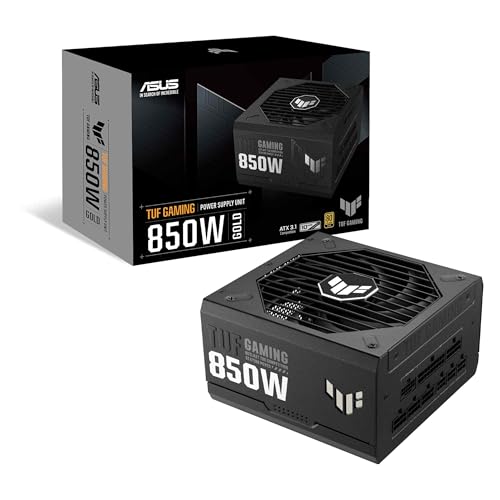
ASUS TUF Gaming 850W Gold Power Supply
Best for: High-performance gaming builds needing 850W
- Size
- 850W (what this guide is about)
- Wattage
- 850W
- Efficiency Rating
- 80 Plus Gold
- Modularity
- Fully Modular
- ATX Version
- ATX 3.1
- PCIe Connector Type
- 12V-2x6
View on Amazon: ASUS TUF Gaming 850W Gold Power Supply Affiliate link
This 850W power supply meets ATX 3.1 standards and carries an 80 Plus Gold efficiency rating. It includes a 16-pin PCIe cable for Gen 5.0 graphics cards. The unit features military-grade capacitors and a dual ball fan for longevity. Weighing 5.46 pounds, it measures 5.9 by 3.4 by 5.9 inches. It suits gamers needing reliable high-wattage output.
Pros
- 80 Plus Gold efficiency rating
- ATX 3.1 compatible with 16-pin PCIe cable
- Military-grade certified capacitors and chokes
- Dual ball fan bearings for extended lifespan
Cons
- Heavier than some competitors at 5.46 pounds
- Semi-modular design requires managing cables
- No mention of smart monitoring software
Good fit if
- You need 850W for high-end GPUs
- You want ATX 3.1 and PCIe 5.0 support
- You prioritize component durability and certification
Skip if
- You require a fully modular cable setup
- You need a lower wattage like 650W
- You prefer a lighter, more compact unit
Verdict: ASUS TUF Gaming 850W Gold PSU offers robust build quality and modern connectivity for gamers. It fits users who value certified efficiency and durable internal components for their high-performance rigs.

Thermaltake Smart BM3 750W Semi-Modular PSU
Best for: Mid-range builds needing ATX 3.1 support
- Size
- 750W (what this guide is about)
- Wattage
- 750W
- Efficiency Rating
- 80Plus Bronze
- Modularity
- Semi-Modular
- ATX Version
- ATX 3.1
- Fan Size
- 120mm
View on Amazon: Thermaltake Smart BM3 750W Semi-Modular PSU Affiliate link
This 750W power supply carries an 80 Plus Bronze efficiency rating and supports ATX 3.1 standards. It features a semi-modular design, meaning you connect only the cables you need. A 120mm fan with Smart Zero Fan technology keeps noise low during light loads. The unit includes Japanese main capacitors rated for 105°C operation. It fits standard ATX cases and suits users building mid-range systems that need reliable power without full modularity.
Pros
- 80 Plus Bronze efficiency certification
- ATX 3.1 and PCIe 5.0 ready
- Semi-modular cable management
- 105°C Japanese main capacitors
- 5-year warranty coverage
Cons
- Semi-modular design requires managing fixed cables
- Bronze rating is less efficient than Gold options
- Heavier at 3.6 pounds than some competitors
Good fit if
- You need ATX 3.1 compatibility for new GPUs
- You want a balance of cost and modularity
- You are building a mid-range PC
Skip if
- You require full modular cables for clean builds
- You need Gold efficiency for lower heat
- You prefer lighter power supplies for small cases
Verdict: Thermaltake Smart BM3 750W is a solid choice for builders who want modern ATX 3.1 support without the cost of full modularity. It fits users prioritizing capacitor quality and standard ATX form factors.

Vetroo 1000W White Power Supply
Best for: high-wattage builds needing ATX 3.1 support
- Size
- 1000W (what this guide is about)
- Wattage
- 1000W
- Efficiency Rating
- 80 Plus Gold
- Modularity
- Full Modular
- ATX Version
- ATX 3.1
- PCIe Connector Type
- PCIe 5.1
View on Amazon: Vetroo 1000W White Power Supply Affiliate link
This Vetroo unit delivers 1000W of power with 80 Plus Gold efficiency. It supports the latest ATX 3.1 standard and PCIe 5.1 connectors. The full modular design helps you manage cables easily. It uses premium 105°C capacitors for stable operation. This size suits builders needing high wattage in a standard ATX form factor.
Pros
- 1000W output capacity
- 80 Plus Gold efficiency rating
- ATX 3.1 and PCIe 5.1 ready
- Full modular cable design
- 105°C rated capacitors
Cons
- Larger 1000W size compared to 650W or 750W options
- White color only available for this wattage
- Higher power draw may not suit low-end builds
Good fit if
- You need 1000W for high-end GPUs
- You want ATX 3.1 compatibility
- You prefer full modular cable management
Skip if
- You require a smaller 650W or 750W form factor
- You need black color options for this wattage
- You are building a low-power system
Verdict: Vetroo 1000W ATX 3.1 Gold PSU offers high wattage and modern connectivity for demanding builds. It fits users who prioritize efficiency and future-proof PCIe standards over compact size.

MSI MAG A650BN 650W Non-Modular PSU
Best for: standard builds needing basic protection
- Size
- 650W (what this guide is about)
- Wattage
- 650W
- Efficiency Rating
- 80+ Bronze
- Modularity
- Non-Modular
- Warranty
- 5 Year
- Form Factor
- Compact
View on Amazon: MSI MAG A650BN 650W Non-Modular PSU Affiliate link
The MSI MAG A650BN is a 650W power supply with 80 Plus Bronze efficiency. It features a non-modular design and active PFC for stable power delivery. The unit includes industrial-level protections like OVP and OCP. It measures 8.66 inches long and weighs 2.2 pounds. This model suits users who need reliable performance in a compact, budget-friendly form factor without modular cable management.
Pros
- 650W output capacity
- 80 Plus Bronze efficiency rating
- Active PFC design
- 5-year warranty coverage
- Industrial protection circuits
Cons
- Non-modular cable design
- 80 Plus Bronze efficiency is lower than Gold options
- No ATX 3.1 or PCIe 5.1 certification
Good fit if
- You need a reliable 650W unit for standard builds
- You prefer a fixed cable setup for simplicity
- You want industrial protection features at a lower efficiency tier
Skip if
- You require full modularity for clean cable management
- You need ATX 3.1 compatibility for new GPUs
- You want 80 Plus Gold efficiency or higher
Verdict: MSI MAG A650BN 650W Non-Modular is a practical choice for builders who prioritize basic efficiency and protection over modularity or modern PCIe standards.

Redragon 750W Gold Modular RGB PSU
Best for: Compact cases needing tidy 750W power
- Size
- 750W (what this guide is about)
- Wattage
- 750 Watt
- Efficiency Rating
- 80+ Gold
- Modularity
- Fully Modular
- Form Factor
- Compact
- Dimensions
- 11.8 × 7.87 × 4.72 inches
View on Amazon: Redragon 750W Gold Modular RGB PSU Affiliate link
The Redragon RGPS-750W is a 750-watt ATX power supply with 80 Plus Gold efficiency. It features fully modular flat black cables and a compact 160mm design. The unit includes Japanese capacitors and a zero-RPM fan mode for quiet operation. It suits users who want efficient power delivery and tidy cable management in a mid-sized case without needing the latest ATX 3.1 standard.
Pros
- 80 Plus Gold efficiency rating
- Fully modular flat black cables
- Compact 160mm chassis size
- Zero RPM fan mode
Cons
- Lacks ATX 3.1 or PCIe 5.1 native support
- No app or software control for RGB
- RGB lighting limited to fan only
Good fit if
- You need 750W of reliable power
- You want fully modular cables
- You prefer a compact 160mm size
Skip if
- You require ATX 3.1 compatibility
- You need PCIe 5.1 native support
- You want remote or app control
Verdict: Redragon 750W Gold Fully Modular delivers efficient power in a compact form factor. It fits builders who prioritize cable management and quiet operation over the newest connector standards.

Corsair 650W Semi-Modular ATX Power Supply
Best for: clean cable management in mid-range builds
- Size
- 650W (what this guide is about)
- Wattage
- 650 Watt
- Efficiency Rating
- 80 Plus Bronze
- Modularity
- Semi-Modular
- Form Factor
- ATX
- Dimensions
- 5.91 × 5.51 × 3.39 inches
View on Amazon: Corsair 650W Semi-Modular ATX Power Supply Affiliate link
The Corsair CX650M is a 650W ATX power supply with 80 Plus Bronze efficiency. It uses semi-modular cabling, letting you connect only what you need. Japanese capacitors rated for 105 degrees Celsius ensure reliability. The rifle bearing fan supports low-noise operation. This unit suits builders who want clean cable management without the cost of full modularity.
Pros
- Semi-modular design for easier cable management
- 80 Plus Bronze efficiency certification
- Japanese capacitors rated up to 105 degrees Celsius
- Rifle bearing fan for low-noise operation
Cons
- Lower 80 Plus Bronze efficiency compared to Gold units
- Semi-modular design still requires some fixed cables
- Heavier at 5.01 pounds than compact alternatives
Good fit if
- You need semi-modular cabling for cleaner builds
- You want reliable Japanese capacitors for longevity
- You prefer low-noise operation for quiet PCs
Skip if
- You require full modularity for maximum flexibility
- You need high-efficiency Gold or Platinum ratings
- You want the lightest possible power supply
Verdict: Corsair CX650M 650W Semi-Modular is a practical option for users who value clean cable management and reliable components over peak efficiency. It fits mid-range builds where noise levels and component quality matter more than maximum power savings.
Specifications side by side
| Spec | ASUS TUF Gaming 850W Gold Power Supply | Thermaltake Smart BM3 750W Semi-Modular PSU | Vetroo 1000W White Power Supply | MSI MAG A650BN 650W Non-Modular PSU | Redragon 750W Gold Modular RGB PSU | Corsair 650W Semi-Modular ATX Power Supply |
|---|---|---|---|---|---|---|
| Wattage | 850W | 750W | 1000W | 650W | 750 Watt | 650 Watt |
| Efficiency Rating | 80 Plus Gold | 80Plus Bronze | 80 Plus Gold | 80+ Bronze | 80+ Gold | 80 Plus Bronze |
| Modularity | Fully Modular | Semi-Modular | Full Modular | Non-Modular | Fully Modular | Semi-Modular |
| ATX Version | ATX 3.1 | ATX 3.1 | ATX 3.1 | not stated | not stated | not stated |
| PCIe Connector Type | 12V-2x6 | not stated | PCIe 5.1 | not stated | not stated | not stated |
| Fan Size | not stated | 120mm | 120mm | not stated | not stated | not stated |
| Warranty | 10-Year | 5 Year | 10 Year | 5 Year | not stated | not stated |
| Form Factor | ATX | ATX | Compact | Compact | Compact | ATX |
| PCIe Version | PCIe 5.1 | not stated | PCIe 5.1 | not stated | not stated | not stated |
| Recommended Use | Gaming | not stated | Gaming | not stated | not stated | not stated |
| Connector | 12V-2x6 Connector | not stated | not stated | not stated | not stated | not stated |
| Power Factor Correction | not stated | not stated | not stated | Active PFC | not stated | not stated |
| Size | 850W | 750W | 1000W | 650W | 750W | 650W |
| Device Compatibility | not stated | not stated | PCs | not stated | not stated | not stated |
| Dimensions | 5.9 × 5.9 × 3.4 inches | 5.9 × 5.5 × 3.4 inches | 5.9 × 5.5 × 3.4 inches | 5.91 × 5.51 × 3.39 inches | 11.8 × 7.87 × 4.72 inches | 5.91 × 5.51 × 3.39 inches |
| Weight | 5.46 pounds | 3.6 pounds | not stated | 2.2 pounds | not stated | 5.01 pounds |
| Color | TUF-GAMING-850G | Black | 1000W-White | Black | not stated | Black |
| Model | TUF-GAMING-850G | SPD-750AH2CLB | 1000G5 | 306-7ZP2B11-CE0 | PSU006 | CP-9020221-NA |
For vehicle storage, you have roof cargo box size explained to compare external dimensions and internal storage capacity.
Frequently asked questions
Is a 1000W power supply physically larger than a 650W unit?
No. Wattage indicates electrical output, not physical dimensions. Most units use standard ATX form factors regardless of power rating. For example, the Vetroo 1000W and MSI MAG A650BN share similar width and height profiles. Always check the specific length and width specs to ensure compatibility with your case.
Does a higher wattage size mean the PSU is louder?
Not necessarily. Noise levels depend on the fan design and load, not just the wattage rating. The Redragon 750W Gold Modular is noted for quiet operation despite its higher efficiency rating. You should look for specific noise data or user feedback if silence is your primary concern.
Can I use a 750W power supply in a small case?
It depends on the unit's physical length. The Thermaltake Smart BM3 750W measures 5.9 inches in length, fitting standard ATX cases. However, the Redragon 750W is significantly longer at 11.8 inches. You must verify the internal dimensions of your case before purchasing a higher-wattage unit.
Is 850W considered a large size for gaming builds?
It is a mid-range wattage for modern gaming rigs. The ASUS TUF Gaming 850W Gold is designed for high-performance builds. Its physical size is standard, measuring 5.9 inches in width and length. This wattage balances power needs for high-end GPUs without requiring the bulk of a 1000W unit.
Do all power supplies with the same wattage have the same weight?
No. Weight varies based on internal components and build quality. The MSI MAG A650BN weighs 2.2 pounds, while the Corsair 650W Semi-Modular weighs 5.01 pounds. Both are 650W units, but the heavier unit may contain more robust internal parts for durability and stability.
Will a 1200W power supply fit in any PC case?
Likely not. High-wattage units often require larger cases due to their physical size and heat output. The guide lists sizes up to 1200W, implying these are for larger builds. You need to check the maximum PSU length your case supports, as these units often exceed standard 5.9-inch lengths.