ATX Version Explained: What It Means for PC Power Supplies
As an Amazon Associate we earn from qualifying purchases. Links on this page are affiliate links.
Understanding ATX Version Specs
The ATX version defines the electrical and physical standards for your power supply unit. This specification ensures compatibility with your motherboard and components. It dictates voltage tolerances, connector types, and signal behaviors. When you check the atx version explained, you are looking at the rulebook that governs how power flows from the wall to your PC.
Two main versions dominate the current market: ATX 3.0 and ATX 3.1. These are not just minor tweaks. They represent significant shifts in how modern hardware handles power demands. ATX 3.0 introduced the 12VHPWR connector. This single cable can deliver up to 600 watts. It replaced the need for multiple PCIe power cables on high-end graphics cards. This simplifies cable management and reduces clutter inside your case.
ATX 3.1 builds on that foundation. It refines the transient response requirements. Transient spikes are sudden, short bursts of power demand. Modern GPUs create these spikes when rendering complex scenes. ATX 3.1 ensures the power supply can handle these spikes without shutting down or causing instability. It also tightens voltage regulation standards. This means your components receive cleaner, more stable power during peak loads.
You will see these versions listed in product specifications. Look for the exact label on the packaging or the retailer’s data sheet. Do not assume backward compatibility without checking. While ATX 3.0 units often work with older boards, the reverse is not always true for new connectors. The 12VHPWR connector requires specific pins. An older ATX 2.4 unit cannot provide this.
Why does this matter to you? If you are building a new system with a latest-generation graphics card, you need the correct version. Using an outdated unit can lead to performance throttling or system crashes. The version number tells you if the unit is ready for today’s hardware. It is a quick check for future-proofing. Choose the version that matches your component requirements to ensure a stable and efficient build.
ATX 3.0 vs 3.1 Differences
ATX 3.0
ATX 3.0 introduced the 12V-2x6 connector, replacing the older 8-pin PCIe power cables. This change simplifies connections for modern graphics cards and reduces the risk of loose fittings. It supports PCIe 5.0 standards, which helps manage transient power spikes common in high-end GPUs. You will find this version in units like the Corsair RM1000x Shift. It is a solid choice for builders who prioritize high wattage and established compatibility. The trade-off is that it does not support the newer PCIe 5.1 signaling. If your system uses older components or you do not need the latest connector updates, ATX 3.0 remains a reliable and efficient standard for gaming builds.
ATX 3.1
ATX 3.1 is the latest iteration, offering improved compatibility with PCIe 5.1 GPUs. It refines the 12V-2x6 connector design for even greater stability and safety. This version ensures your power supply can handle the most demanding current requirements of next-generation graphics cards. The MSI MAG 850W and Corsair RM850x Shift both adhere to this standard. It is ideal for gamers upgrading to the newest hardware who want long-term relevance. The main benefit is future-proofing your build against evolving power demands. However, it may come with a slight premium over older standards. If you plan to keep your system for many years, choosing ATX 3.1 ensures you meet the latest industry benchmarks for efficiency and connectivity.
Is This Spec Worth Your Attention
Who needs it
You need to pay close attention to the ATX version if you are building a high-end gaming PC or a workstation with a modern graphics card. The ATX 3.0 and 3.1 standards introduce the 12V-2x6 connector, which is essential for newer GPUs. These connectors handle higher power spikes more safely than older designs. If your motherboard and GPU require this specific interface, an older PSU will not work. The ATX 3.1 revision offers slightly tighter voltage tolerances and improved transient response. This matters for stability during intense gaming sessions or rendering tasks. You should prioritize this spec to ensure your expensive components receive clean, reliable power. Ignoring it could lead to compatibility issues or potential hardware damage during power surges.
Who can skip it
You can safely ignore the specific ATX version if you are upgrading an older system or building a budget PC with mid-range components. Older motherboards and graphics cards use standard 8-pin PCIe connectors, which remain compatible with many modern units. If your current setup runs fine, you do not need to chase the latest standard just for the sake of it. Focus instead on wattage, efficiency ratings, and cable management. These factors have a more immediate impact on daily performance and noise levels. The ATX 3.1 improvements are marginal for most casual users. You will not notice the difference in voltage stability during normal web browsing or office work. Save your effort for checking the brand reputation and warranty terms. Those details matter more for long-term reliability in entry-level builds.
ATX Glossary Terms
ATX Version
The specific revision of the standard. It defines physical dimensions, connector layouts, and electrical tolerances for compatibility with modern motherboards and components.
12V-2x6 Connector
A new power interface for graphics cards. It replaces older 8-pin cables to handle higher transient power spikes safely without risk of melting.
Efficiency Rating
How well the unit converts AC to DC power. Ratings range from 80 Plus Bronze to Titanium. Higher ratings mean less wasted energy as heat.
Form Factor
The physical size and shape of the power supply. ATX is standard for most desktops. SFX is smaller for compact cases. Ensure it fits your chassis.
Modularity
Whether cables detach from the unit. Fully modular units let you connect only what you need. This improves airflow and simplifies cable management inside the case.
Voltage Regulation
The ability to maintain stable voltage under load. Good regulation prevents fluctuations that can damage sensitive components like CPUs or GPUs during heavy workloads.
PCIe Version
The generation of the graphics card interface. PCIe 5.0 supports newer GPUs. The power supply must support the corresponding connector standards for these cards.
Topology
The internal circuit design of the PSU. Topologies like LLC or DC-DC affect efficiency and ripple. They determine how power is processed before reaching your components.
Waveform
The shape of the electrical current output. A clean sine wave is ideal. Switching power supplies produce square waves. Filtering ensures stable DC output for stability.
Quick picks
| # | Product | Best for | Price |
|---|---|---|---|
| 1 | MSI MAG 850W Fully Modular ATX Power Supply | ATX 3.1 gaming builds | Check price of MSI MAG 850W Fully Modular ATX Power Supply on Amazon |
| 2 | Corsair RM1000x Shift 1000W Power Supply | High-wattage ATX 3.0 builds | Check price of Corsair RM1000x Shift 1000W Power Supply on Amazon |
| 3 | Corsair RM850x Shift 850W White ATX Power Supply | Modern high-end gaming builds | Check price of Corsair RM850x Shift 850W White ATX Power Supply on Amazon |
| 4 | MSI MAG ATX 3.0 Modular Power Supply | Gaming builds needing PCIe 5.0 support | Check price of MSI MAG ATX 3.0 Modular Power Supply on Amazon |
| 5 | Corsair RM1000x 1000W ATX 3.1 PSU | High-wattage ATX 3.1 builds | Check price of Corsair RM1000x 1000W ATX 3.1 PSU on Amazon |
| 6 | GAMEMAX 1050W ARGB Fully Modular PSU | High-wattage gaming builds with ARGB needs | Check price of GAMEMAX 1050W ARGB Fully Modular PSU on Amazon |
Our 6 picks

MSI MAG 850W Fully Modular ATX Power Supply
Best for: ATX 3.1 gaming builds
- ATX Version
- ATX 3.1 (what this guide is about)
- Wattage
- 850W
- Efficiency Rating
- 80+ Gold
- Modularity
- Fully Modular
- PCIe Connector Type
- 12V-2x6
- Warranty
- 10 Year
View on Amazon: MSI MAG 850W Fully Modular ATX Power Supply Affiliate link
The MSI MAG A850GL is a fully modular 850W power supply built for modern gaming rigs. It supports the ATX 3.1 standard and PCIe 5.1, featuring a single 12V-2x6 connector for next-gen graphics cards. The unit holds an 80 Plus Gold efficiency rating and comes with a 10-year warranty. Its compact dimensions help fit into smaller cases while delivering stable power for high-end components.
Pros
- ATX 3.1 compliance for latest standards
- 10-year manufacturer warranty
- 80 Plus Gold efficiency rating
- Fully modular cable design
Cons
- 850W may limit extreme multi-GPU setups
- 12V-2x6 connector only, no native 16-pin support
- Larger physical footprint than some competitors
Good fit if
- You need ATX 3.1 and PCIe 5.1 readiness
- You want a 10-year warranty for peace of mind
- You are building a high-end gaming PC
Skip if
- You require more than 850W of power
- You need native 16-pin PCIe 5.0 connectors
- You are building a low-power office system
Verdict: MSI MAG A850GL ATX 3.1 850W fits gamers upgrading to PCIe 5.1 GPUs who want a long-term warranty. It delivers efficient power in a modular form factor suitable for most mid-tower cases.

Corsair RM1000x Shift 1000W Power Supply
Best for: High-wattage ATX 3.0 builds
- ATX Version
- ATX 3.0 (what this guide is about)
- Wattage
- 1000W
- Efficiency Rating
- 80 Plus Gold
- Modularity
- Fully Modular
- Dimensions
- 7.09 × 5.91 × 5.08 inches
- Weight
- 4.2 pounds
View on Amazon: Corsair RM1000x Shift 1000W Power Supply Affiliate link
This Corsair RM1000x Shift power supply delivers 1000W of power with an ATX 3.0 standard. It features fully modular cabling and 80 Plus Gold efficiency. The side-mounted modular interface helps manage cable routing in compact cases. Its dimensions are 5.91 by 5.08 by 7.09 inches. It weighs 4.2 pounds. This unit suits builders needing high wattage and modern connectivity.
Pros
- 1000W output capacity
- ATX 3.0 compliance
- Fully modular design
- 80 Plus Gold efficiency
Cons
- ATX 3.0 version instead of newer ATX 3.1
- Heavier build at 4.2 pounds
- Side interface requires specific case compatibility
Good fit if
- You need 1000W for high-end GPUs
- You want ATX 3.0 PCIe 5.0 support
- You prefer fully modular cabling
Skip if
- You require ATX 3.1 specifications
- You need a lower wattage unit
- You prefer non-modular simplicity
Verdict: Corsair RM1000x Shift ATX 3.0 offers 1000W power and ATX 3.0 compliance for demanding builds. It fits users who prioritize high wattage and modern PCIe 5.0 readiness over the latest ATX 3.1 standard.

Corsair RM850x Shift 850W White ATX Power Supply
Best for: Modern high-end gaming builds
- ATX Version
- ATX 3.1 (what this guide is about)
- Wattage
- 850W
- Efficiency Rating
- 80 Plus Gold
- Modularity
- Fully Modular
- PCIe Connector Type
- PCIe 5.1
- Dimensions
- 6.3 × 5.91 × 3.39 inches
View on Amazon: Corsair RM850x Shift 850W White ATX Power Supply Affiliate link
This is a fully modular 850W power supply built for modern systems. It supports the latest ATX 3.1 standard and PCIe 5.1 connectors for high-end graphics cards. The unit carries an 80 Plus Gold efficiency rating to reduce waste heat. It measures 6.3 inches long and weighs 3.75 pounds. You should choose this if you need reliable power delivery for a new build.
Pros
- Supports ATX 3.1 specification
- Includes PCIe 5.1 connector
- 80 Plus Gold efficiency rating
- Fully modular cable design
Cons
- Limited to 850W output
- Heavier than some compact units
- No app control mentioned
Good fit if
- You are building a high-end gaming PC
- You need ATX 3.1 compatibility
- You prefer fully modular cables
Skip if
- You need more than 850W
- You want a smaller form factor
- You require smart monitoring features
Verdict: Corsair RM850x Shift ATX 3.1 delivers solid 850W power with modern ATX 3.1 support. It fits users who prioritize efficiency and the latest connector standards for their graphics cards.

MSI MAG ATX 3.0 Modular Power Supply
Best for: Gaming builds needing PCIe 5.0 support
- ATX Version
- ATX 3.0 (what this guide is about)
- Efficiency Rating
- 80 Plus Gold
- Modularity
- Full Modular
- PCIe Connector Type
- PCIe 5.0
- Fan Size
- 120mm
- Recommended Use
- Gaming
View on Amazon: MSI MAG ATX 3.0 Modular Power Supply Affiliate link
The MSI MAG A750GL is a full modular power supply built for ATX 3.0 systems. It features an 80 Plus Gold efficiency rating and a native PCIe 5.0 connector for modern graphics cards. The unit uses a 120mm fluid dynamic bearing fan and includes industrial-level protections like OVP and OCP. This model suits gamers who need reliable power delivery and high efficiency for their builds.
Pros
- ATX 3.0 compatible with native PCIe 5.0 connector
- 80 Plus Gold efficiency rating
- Full modular design with flat cables
- 120mm fluid dynamic bearing fan
Cons
- Larger dimensions than compact ATX 3.1 models
- Heavier build at 3.97 pounds
- Sold as a renewed product
Good fit if
- You need native PCIe 5.0 support for RTX 40 series cards
- You want high efficiency with 80 Plus Gold certification
- You prefer full modular cabling for cleaner builds
Skip if
- You require a compact form factor to fit small cases
- You need the latest ATX 3.1 standard
- You prefer new units over renewed stock
Verdict: The MSI MAG A750GL ATX 3.0 delivers solid efficiency and modern connectivity for gaming rigs. It fits users who prioritize PCIe 5.0 support and gold-level performance over compact size.

Corsair RM1000x 1000W ATX 3.1 PSU
Best for: High-wattage ATX 3.1 builds
- ATX Version
- ATX 3.1 (what this guide is about)
- Wattage
- 1000W
- Efficiency Rating
- Cybenetics Gold
- Modularity
- Fully Modular
- PCIe Connector Type
- 12V-2x6
- PCIe Version
- PCIe 5.1
View on Amazon: Corsair RM1000x 1000W ATX 3.1 PSU Affiliate link
The Corsair RM1000x is a fully modular ATX 3.1 power supply rated at 1000W. It supports PCIe 5.1 via a 12V-2x6 connector and carries a Cybenetics Gold efficiency rating. Measuring 2.3 inches in length, it fits compact cases. This unit suits builders needing high wattage and the latest ATX standard without bulky dimensions.
Pros
- 1000W output capacity
- ATX 3.1 compliance
- PCIe 5.1 support
- Cybenetics Gold efficiency
- Compact 2.3-inch length
Cons
- Heavier than competitors at 6.88 pounds
- 12V-2x6 connector requires adapter for older GPUs
- No visible voltage or load display
Good fit if
- You need 1000W for high-end GPUs
- You want ATX 3.1 compatibility
- You have a small form factor case
Skip if
- You prefer standard ATX 2.4 units
- You need 80 Plus Platinum efficiency
- You want a lighter power supply
Verdict: Corsair RM1000x ATX 3.1 delivers 1000W in a compact frame for users building with the latest ATX 3.1 standard. It fits builders prioritizing modern PCIe 5.1 support and efficient power delivery in tight spaces.
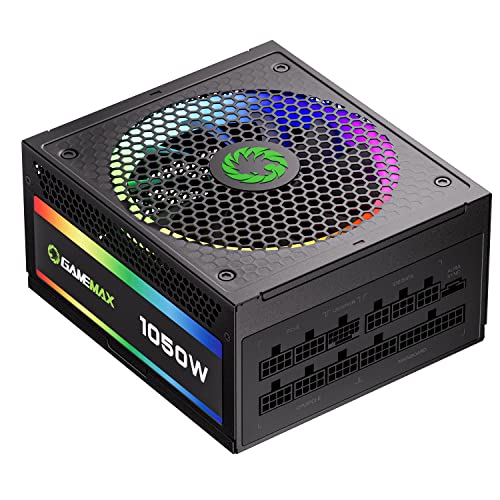
GAMEMAX 1050W ARGB Fully Modular PSU
Best for: High-wattage gaming builds with ARGB needs
- ATX Version
- ATX 3.0 (what this guide is about)
- Wattage
- 1050W
- Efficiency Rating
- 80 Plus Gold
- Modularity
- Fully Modular
- PCIe Connector Type
- 12VHPWR 16pin
- Fan Size
- 140mm
View on Amazon: GAMEMAX 1050W ARGB Fully Modular PSU Affiliate link
This GAMEMAX unit delivers 1050W of power with an ATX 3.0 standard and 80 Plus Gold efficiency. It includes a 12VHPWR 16-pin connector for modern GPUs and supports PCIe 5.0 excursions. The fully modular design reduces cable clutter. You can sync the ARGB lighting with motherboard software. The 140mm fan aims for quiet operation. It suits gamers needing high wattage and visual customization.
Pros
- 1050W capacity with 80 Plus Gold efficiency
- ATX 3.0 standard with 12VHPWR 16-pin connector
- Fully modular cable management
- ARGB sync with motherboard software
Cons
- Heavier at 3.53 pounds compared to compact alternatives
- Larger dimensions may not fit small cases
- ATX 3.0 version lacks PCIe 5.0 native support
Good fit if
- You need high wattage for future GPUs
- You want ARGB lighting synchronization
- You prefer fully modular cables
Skip if
- You require ATX 3.1 compliance
- You have a small form factor case
- You prefer silent zero-RPM fan modes
Verdict: GAMEMAX 1050W ATX 3.0 Power Supply fits users who prioritize high power output and RGB customization over compact size. It is a solid choice for standard ATX cases needing robust GPU support.
Specifications side by side
| Spec | MSI MAG 850W Fully Modular ATX Power Supply | Corsair RM1000x Shift 1000W Power Supply | Corsair RM850x Shift 850W White ATX Power Supply | MSI MAG ATX 3.0 Modular Power Supply | Corsair RM1000x 1000W ATX 3.1 PSU | GAMEMAX 1050W ARGB Fully Modular PSU |
|---|---|---|---|---|---|---|
| Wattage | 850W | 1000W | 850W | not stated | 1000W | 1050W |
| Efficiency Rating | 80+ Gold | 80 Plus Gold | 80 Plus Gold | 80 Plus Gold | Cybenetics Gold | 80 Plus Gold |
| Modularity | Fully Modular | Fully Modular | Fully Modular | Full Modular | Fully Modular | Fully Modular |
| ATX Version | ATX 3.1 | ATX 3.0 | ATX 3.1 | ATX 3.0 | ATX 3.1 | ATX 3.0 |
| PCIe Connector Type | 12V-2x6 | not stated | PCIe 5.1 | PCIe 5.0 | 12V-2x6 | 12VHPWR 16pin |
| Fan Size | not stated | not stated | not stated | 120mm | not stated | 140mm |
| Warranty | 10 Year | not stated | not stated | not stated | not stated | not stated |
| Form Factor | ATX | ATX | ATX | ATX | ATX | ATX |
| PCIe Version | PCIe 5.1 | not stated | PCIe 5.1 | not stated | PCIe 5.1 | not stated |
| Recommended Use | Gaming | not stated | not stated | Gaming | not stated | Gaming |
| Connector | 12V-2x6 Connector | not stated | not stated | not stated | 12V-2x6 Connector | not stated |
| Size | 850W (PCIE 5) | 1000W | 850W | not stated | 1000W | ARGB PRO SERIES |
| Dimensions | 12 × 8.75 × 4.92 inches | 7.09 × 5.91 × 5.08 inches | 6.3 × 5.91 × 3.39 inches | 11.8 × 7.9 × 3.9 inches | 2.3 × 3.39 × 5.91 inches | 6.61 × 5.91 × 3.35 inches |
| Weight | not stated | 4.2 pounds | 3.75 pounds | 3.97 pounds | 6.88 pounds | 3.53 pounds |
| Color | not stated | Black | White | not stated | Black | not stated |
| Model | not stated | not stated | not stated | not stated | not stated | GMX-RGB-1050PRO |
Frequently asked questions
Does ATX 3.1 support the latest graphics cards?
Yes, ATX 3.1 supports the newest GPU standards. The MSI MAG 850W and Corsair RM850x Shift both comply with this version. They feature PCIe 5.1 readiness. This ensures your power supply handles the power demands of modern high-end graphics cards. You get future-proof connectivity for your build.
What is the main connector change in ATX 3.0?
ATX 3.0 introduced the 12V-2x6 connector. This replaces older 8-pin PCIe cables. It simplifies connections for modern graphics cards. Products like the Corsair RM1000x Shift use this standard. It reduces the risk of loose fittings and improves safety for your high-power components.
Is ATX 3.0 still relevant for new builds?
ATX 3.0 remains relevant for demanding builds. It supports PCIe 5.0 standards and the 12V-2x6 connector. The MSI MAG ATX 3.0 Modular and GAMEMAX 1050W offer solid efficiency. They fit users who prioritize modern connectivity. You get robust GPU support without needing the absolute latest revision.
How does ATX version affect compatibility?
The ATX version dictates physical dimensions and electrical tolerances. It ensures your power supply fits your case and motherboard. ATX 3.1 units like the Corsair RM1000x provide compact frames for tight spaces. ATX 3.0 units offer standard dimensions. Checking the version guarantees your components work together safely.
Which ATX version is best for gaming?
ATX 3.1 is ideal for modern gaming builds. It supports PCIe 5.1 and the 12V-2x6 connector. The MSI MAG 850W and Corsair RM850x Shift are top picks. They deliver efficient power for high-end GPUs. You get the latest standards for transient power handling and stable performance.
Do I need ATX 3.1 for a mid-range PC?
ATX 3.0 is sufficient for many mid-range builds. It includes the 12V-2x6 connector and PCIe 5.0 support. The MSI MAG ATX 3.0 Modular offers gold-level efficiency. You get modern connectivity without paying for the newest revision. It is a practical choice for standard gaming rigs.
What does PCIe 5.1 readiness mean?
PCIe 5.1 readiness means the power supply supports the latest graphics card power standards. ATX 3.1 units like the MSI MAG 850W feature this capability. It handles higher transient power spikes. You ensure stable voltage delivery for your most powerful components. This is crucial for high-end gaming systems.