Optimal Shop 20+4 Pin LCD Power Review (2026): A Spec-Based Look
As an Amazon Associate we earn from qualifying purchases. Links on this page are affiliate links.
This tool simplifies power supply diagnostics for your PC builds. In this optimal shop 20 4 pin LCD computer review, we look at a compact tester designed for ATX systems. It features a 1.8-inch LCD screen that displays output voltages clearly. The device also includes a buzzer alarm to signal PG number failures. Built with an aluminum alloy shell, it is lightweight and durable. Measuring 3.7 inches wide and 8.3 inches long, it fits easily in your toolkit. This spec-based look explains how these features help you verify PSU health.
What stands out
- 1.8-inch LCD screen displays output voltage directly from the 20-pin or 24-pin connector
- Buzzer alarm activates when the PG signal fails to indicate power issues
- Aluminum alloy shell provides high strength, good thermal conductivity, and corrosion resistance
- Supports testing for 20-pin IDE, 24-pin IDE, HDD, floppy, PCI-e, and SATA connectors
Who it fits
Good fit for
This tester suits builders and technicians who need to quickly verify PSU voltages without complex equipment. The integrated LCD screen makes reading +12V, +3.3V, and +5V outputs straightforward. Its compact size and light weight make it ideal for mobile technicians or those with limited workspace. If you frequently troubleshoot ATX systems or need to validate multiple connector types, this tool offers a practical, spec-driven solution for ensuring power stability.
Who should skip it
You should look elsewhere if you need a comprehensive diagnostic suite that analyzes ripple or load performance. This device only checks basic voltage presence and the PG signal. It does not provide detailed waveform analysis or efficiency metrics. If you require deep electrical diagnostics beyond simple voltage confirmation, this basic tester will not meet your needs. It is strictly for verifying that the power supply outputs the correct voltages and signals.
Verdict: This tester offers a straightforward way to check PSU voltages and PG signals using its LCD screen and buzzer. It is a practical choice for basic power supply verification tasks.
Key specs explained for PSU tester
8-in-1 ATX power supply tester
This feature means the device supports multiple connector types, including 20-pin, 24-pin, SATA, and PCIe. You can use it to diagnose various power supply outputs without needing different tools. It suits builders who work on diverse PC configurations, from older IDE systems to modern ATX setups. Compare this versatility with single-purpose testers that only check mainboard connectors.
1.8" LCD screen
The small display shows output voltage readings directly. You get clear visual feedback on whether the power supply is delivering correct voltages. This is helpful for quick checks during assembly or troubleshooting. The screen is powered by the connector being tested, so you do not need a separate power source. Compare this to testers that use only LED lights, which can be harder to read in bright environments.
Aluminum alloy shell
The casing is made of metal, which provides durability and helps dissipate heat. You benefit from a device that is lightweight yet sturdy enough for regular use. The material also offers resistance to corrosion. This construction makes it easy to carry in a toolkit. Compare this build quality with plastic-cased testers that may feel fragile or prone to cracking during transport.
Buzzer alarm
The tester emits a sound when it detects a Power Good signal failure. You receive immediate audio feedback if the power supply is not functioning correctly. This allows you to identify issues without staring at the screen. It is useful for hands-free diagnostics or when you are focused on other tasks. Compare this feature with silent testers that require you to constantly monitor visual indicators for errors.
Compact Aluminum Design and Build
The Optimal Shop 20+4 Pin LCD Power Supply Tester features an aluminum alloy shell, according to the listing. This material choice provides high strength while keeping the unit light. It also offers good thermal conductivity and corrosion resistance. You benefit from a durable exterior that can withstand frequent handling during your PC building or repair tasks. The black finish is practical for a tool you might keep in a workbench drawer or tool bag.
In terms of physical dimensions, the device measures 8.3 inches in length, 3.7 inches in width, and 0.8 inches in height. It weighs just 3.2 ounces. These specs make it a compact and portable option. You can easily carry it with you without adding significant bulk to your toolkit. The small footprint ensures it does not take up much space on your work surface when you are not actively using it.
The layout centers around a 1.8-inch LCD screen, which is powered by the 20-pin or 24-pin connector. This display shows output voltages clearly, allowing you to read results without external power sources. The listing notes the screen has a protective film to prevent scratches, which you can remove if desired. A buzzer alarm is integrated to signal when the PG signal fails. This audible cue complements the visual display, ensuring you are aware of power supply issues immediately during your diagnostic process.
Setup And Daily Use
Setting up this tester requires no external power source or software installation. You simply plug the device into the specific connector you wish to evaluate. The 1.8-inch LCD screen draws its power directly from the 20-pin or 24-pin ATX connector. This self-contained design means you do not need to manage separate cables for the display itself. The screen illuminates automatically when connected, allowing you to read the output voltages immediately.
Daily use involves matching the tester to your power supply’s available ports. The unit supports eight connector types, including 20-pin, 24-pin, SATA, PCIe 6-pin, 4-pin, 8-pin, and floppy disk connectors. When you attach the device to HDD, floppy, or PCIe connectors, the indicator on the left side shows the output for +12V, +3.3V, and +5V rails. This layout helps you verify stability across multiple voltage lines simultaneously.
The device includes a buzzer alarm to signal issues. If the PG (Power Good) signal fails, the tester emits an audible alert. This feature provides immediate feedback without requiring you to stare at the screen constantly. The aluminum alloy shell is light and compact, measuring 8.3 inches in length and weighing only 3.2 ounces. You can easily store it in a toolbox or carry it to different workstations. The protective film on the screen should be removed for optimal visibility, as noted in the listing. This tool integrates smoothly into routine PC building and maintenance workflows.
Before you buy this tester
You should verify that your power supply uses standard ATX connectors. This device supports 20-pin, 24-pin, SATA, PCIe, and floppy connectors. If your system uses non-standard or proprietary connectors, this tool may not fit. You also need a compatible motherboard to provide the necessary power for the LCD screen. The screen draws power directly from the 20-pin or 24-pin connector, so your PSU must be able to supply that initial voltage. Keep the protective film on the LCD until you are ready to use it, as the surface scratches easily. Store the unit in a dry place to maintain its aluminum shell integrity. This tester complements other PSU options by providing immediate voltage feedback without complex software. It is ideal for quick checks during assembly or troubleshooting. You do not need external power or drivers. Just plug it in and read the display. It fits well alongside other diagnostic tools in your PC power supplies and UPS guide.
Check before you buy
- Check if your PSU uses standard ATX connectors.
- Ensure your motherboard can power the LCD screen.
- Verify compatibility with your specific SATA or PCIe cables.
- Plan to remove the protective film before first use.
The product at a glance
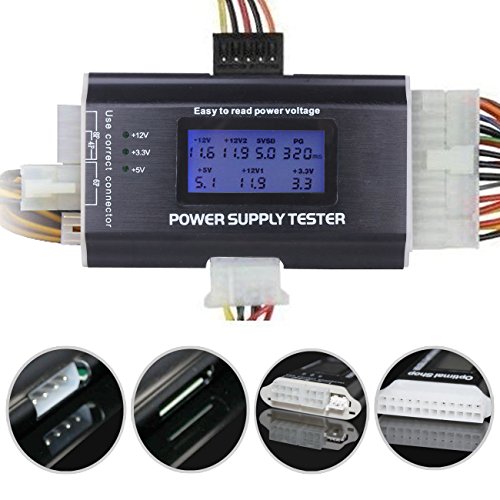
Optimal Shop 20+4 Pin LCD Power Supply Tester
Best for: Verifying ATX power supply voltages and PG status
- Form Factor
- ATX
- Display Type
- LCD Display
- Dimensions
- 8.3 × 3.7 × 0.8 inches
- Weight
- 3.2 ounces
View on Amazon: Optimal Shop 20+4 Pin LCD Power Supply Tester Affiliate link
This device checks ATX power supply voltages across multiple connector types. It features an 1.8-inch LCD screen for clear readings and an aluminum alloy shell for durability. The tester supports 20-pin, 24-pin, SATA, and PCIe connectors. A buzzer alarm signals PG number failures. Its compact size and lightweight design make it easy to handle during routine hardware diagnostics.
Pros
- Tests 8 connector types including 20-pin, 24-pin, SATA, and PCIe
- 1.8-inch LCD screen displays output voltage clearly
- Aluminum alloy shell provides corrosion resistance and heat dissipation
- Built-in buzzer alarm indicates PG number failures
Cons
- Screen has a protective film that requires manual removal
- LCD screen is powered directly by the tested connector
- Limited to basic voltage and PG checks without advanced metrics
Good fit if
- You need a compact tool for checking ATX power supplies
- You want to verify voltage outputs on multiple connector types
- You prefer a device with visual and audible failure alerts
Skip if
- You require testing for non-ATX power supply standards
- You need a display that does not rely on the tested unit
- You want a tool with wireless connectivity or app support
Verdict: Optimal Shop 20+4 Pin LCD Power Tester is a compact, spec-focused tool for verifying ATX power supply voltages. It suits technicians who need quick, visual confirmation of connector outputs and PG status without complex setups.
Specifications side by side
| Spec | Optimal Shop 20+4 Pin LCD Power Supply Tester |
|---|---|
| Form Factor | ATX |
| Display Type | LCD Display |
| Dimensions | 8.3 × 3.7 × 0.8 inches |
| Weight | 3.2 ounces |
| Color | Black |
| Model | Optimal Shop |
Frequently asked questions
Does this tester work with both 20-pin and 24-pin ATX connectors?
Yes, the Optimal Shop 20+4 Pin LCD Power Supply Tester supports both connector types. Its design allows you to plug it directly into either standard ATX power supply outlets. This flexibility lets you verify voltages on older and newer motherboards without needing separate tools for each connector style.
What information does the LCD display show on the screen?
The 1.8-inch LCD screen displays output voltages and Power Good (PG) status. You can see if the power supply is delivering correct voltage levels for each rail. The visual confirmation helps you quickly identify if a PSU is functioning within safe parameters or if it has failed.
How heavy is the Optimal Shop power supply tester?
The unit weighs 3.2 ounces. This light weight makes it easy to handle during bench testing or inside a case. You can carry it in a tool kit without adding significant bulk. The compact form factor ensures it does not take up much space in your workspace.
What are the physical dimensions of this device?
The tester measures 8.3 inches in length, 3.7 inches in width, and 0.8 inches in height. These dimensions create a slim profile that fits easily between motherboard slots or on a workbench. The small footprint allows for convenient storage when you are not actively diagnosing a power supply.
Does this tool require any software installation to function?
No, this device requires no software installation or external power source. It draws power directly from the 20-pin or 24-pin ATX connector you plug it into. This plug-and-play design means you can start testing immediately without configuring drivers or connecting to a computer via USB.
Is the casing made of plastic or metal?
The listing specifies an aluminum alloy shell for this tester. This material provides high strength and good thermal conductivity while keeping the unit lightweight. It also offers corrosion resistance, which helps the device last longer during regular use in various workshop environments.
Can I use this tester to check SATA power connectors?
Yes, the device supports SATA connector testing in addition to ATX. You can use it to diagnose various power supply outputs without needing different tools. This versatility makes it useful for builders who work with multiple connector types on modern motherboards and storage devices.